 | Edition 01 · August 2026 |
| | | | | | The Diagonal | | | | A hedge fund manager’s read on markets |
|  |
| | | | | A word from the strategist Dear Investor, AG Capital is built for active investing. We run long/short strategies, take clear views, and commit capital where our research identifies compelling asymmetry. We use leverage selectively where the prospective return justifies the risk, and we are prepared to go net short where the opportunity warrants. This approach has not always been easy to advocate in an era dominated by passive investing, where owning the index has often been cheaper, simpler and, for much of the past decade, highly rewarding. Capital has followed performance, performance has reinforced the argument, and the argument has steadily hardened into orthodoxy. That backdrop is becoming less forgiving. Markets sit near record levels, valuations in parts of the market are stretched, and index returns have become increasingly concentrated in a relatively small group of very large companies and dominant themes. What appears to be broad diversification can, in practice, resemble a large and crowded consensus position. The longer such a trend persists, the easier it is to regard it not as a cycle, but simply as the way the world works. Yet cycles remain cycles. Recognising a turning point is difficult; repositioning decisively when it arrives is harder still. We believe the current environment increasingly favours managers who are genuinely active - willing to think independently, deviate materially from the benchmark, and adapt as the opportunity set changes. | | | | | | It is in this spirit that we introduce The Diagonal, our new monthly investment newsletter. The name pays subtle homage to a foundational chapter in South African market history - the old Johannesburg Stock Exchange at 17 Diagonal Street. That address was more than a physical location; it alluded to the geometry of capital, ideas and ambition. We see a similar dynamic in today’s markets, where progress rarely follows a straight path and opportunity often emerges from unexpected directions. |
| | | In this inaugural edition, we share our perspective on the current investment landscape, the themes shaping our outlook, and where we believe opportunities are beginning to materialise. Our aim is not to inform, but to give a view on positioning, risk and opportunity. Thank you for your continued trust and confidence in AG Capital. | | | | |  | Casey Sprake Chief Market Strategist · AG Capital | | |
|
| | | | | | | | Diamonds, GPUs and the Perils of Extraordinary Profits Monopoly profits are their own undoing: the bigger prize the larger the incentive to take it away from you. | | | | | | The Diagonal, the name of our occasional newsletter, was chosen carefully. Figuratively, it suggests an unconventional angle on markets, which is really a prerequisite if you’re in active money management. Secondly, many of us at AG Capital grew up at a time when Diagonal Street in Johannesburg was home to South Africa’s capital markets and the beautiful diamond-shaped headquarters of De Beers, the global diamond industry titan and a textbook example of an effective monopoly with a healthy captive market. In 2011, the Oppenheimer family sold its 40% share in the business for US$5.1bn, valuing the company at US$12.75bn. | | | | | | “ | Gradually, and then suddenly - synthetic diamonds commoditised what was previously the most valuable gemstone on earth. | | |
| | | Fast forward to July 2026, and you would have woken up to the headline that Anglo American was in talks to sell its 85% share in the business for US$1bn, a once-unthinkable scenario. The signs were there for a long time, but it’s the old story of “gradually, and then suddenly”. Synthetic diamonds from China unceremoniously commoditised what was previously the most valuable gemstone on earth. De Beers appeared almost unassailable. Yet the extraordinary profits generated by that position created an equally extraordinary prize for anyone able to challenge it, and eventually, technology did what it so often does. Natural competitive forces manifested a cheap alternative, reminding us that permanence in business simply isn’t. It would be a bridge too far to compare Nvidia to De Beers, or a bleeding edge tech company to an earth-moving operation. Nvidia’s dominance has been earned through extraordinary innovation, and its technology and software ecosystem remain extremely difficult to replicate. Artificial intelligence may also prove to be every bit as transformative as its proponents believe. Yet there is an important distinction between the durability of a technological revolution and the durability of the profits being earned by its current leader. Nvidia’s extraordinary margins are not protected from competition by their scale, and in fact their scale makes them a far bigger target. The companies buying Nvidia’s chips are among the largest and best-capitalised businesses the world has ever produced. They are spending hundreds of billions of dollars building AI infrastructure, while simultaneously developing their own chips and searching for ways to reduce their dependence on its most expensive component. Competitors, start-ups and governments are pursuing the same opportunity. This matters because much of the market is now built around a particular construct - that demand for computing power will continue to compound, that the largest technology companies will continue spending at the current pace, and that the trillions of dollars in forecasted capex committed today will earn double-digit returns for many years to come. That construct may prove correct, but if technology changes where the bottleneck sits, the structure of the entire AI trade – and the market - could change with it. Importantly, an alternative scenario where none of this happens doesn’t mean that artificial intelligence disappoints. The technology can transform the world while the market remains wrong about who ultimately makes the money, or about how much money they make. The profits may migrate from chips to models, from infrastructure to applications, or from today’s incumbents to competitors that have not yet emerged. The product may also ultimately become commoditised, where those profits simply don’t come through. A successful technological revolution and a favourable investment outcome are not synonymous. The lesson from Diagonal Street is therefore not that every dominant company is destined to fail. It is that no competitive advantage should be treated as permanent, particularly when the prize for breaking it is so large. Diamonds are as beautiful today as they were 20 years ago, they just cost 90% less. We watched Diagonal Street change and age past its best, and we know this market will change too. Our edge won’t be that we forecast the future more accurately, but rather that we’re willing to adapt more quickly as it reveals itself. We will endeavour to recognise the trend early, and react decisively – and I’m certain that in another ten years we will marvel and just how much things have changed yet again. | | | | | 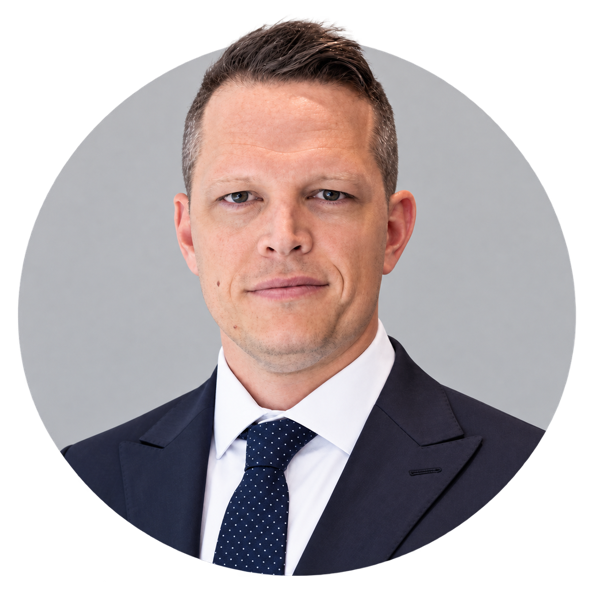 | Henry Biddlecombe Chief Executive Officer · AG Capital | | |
|
| | | | | Puts are Schmutz | | | | | | The old Wall Street adage, “Puts are Schmutz”, casts the selling of out of the money puts as something rather dirty; schmutz meaning dirty in both German and Yiddish, but we at AG Capital do not think the business is quite as grubby as the saying implies. Nor do we see it simply as “picking up nickels in front of a steamroller”, the familiar Wall Street warning that one catastrophic loss will eventually overwhelm a steady stream of small premiums. Whilst the risk is real (and needs to be respected), it does however only form one part of the equation. Done selectively, with discipline and an understanding of where option prices are systematically distorted, selling OTM puts can be less a “reckless grab for yield” than a measured way of underwriting fear at prices that are often too high. | | | | | | “ | Selling OTM puts can be less a “reckless grab for yield” than a measured way of underwriting fear at prices that are often too high. | | |
| | | In his latest piece, our CIO, Adrian de Fay, examines the uncomfortable maths of perpetual portfolio protection, the behavioural pull of “doing something”, and the discipline required to sell fear when it is overpriced - then patiently let theta do the work. | | | | | | | | 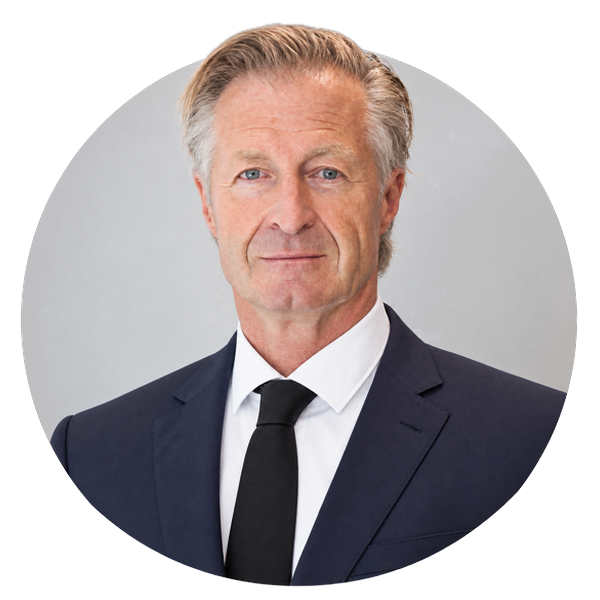 | Adrian de Fay Chief Investment Officer · AG Capital | | |
|
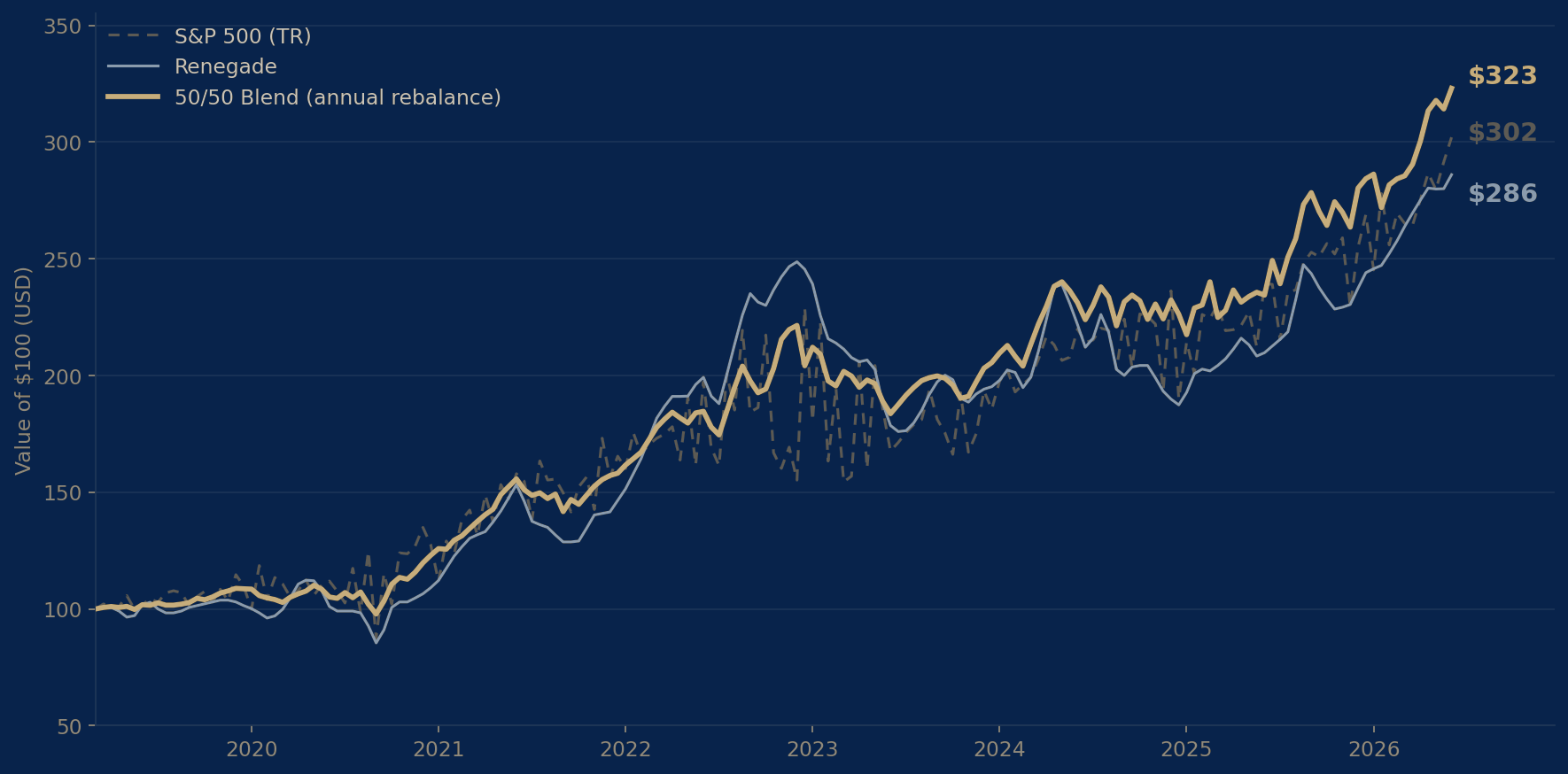
| | | | | Fund spotlight AG Renegade Global Macro SP More return. Less risk. Most investors’ global equity portfolios in 2026 reflect a significant overlap with the S&P 500, due to very common concentrated positioning in the megacap technology companies that have grown in value so tremendously over the last decade. One of the primary use cases for hedge funds, rather than trying to beat such a strong trending market, is to dampen its volatility while enhancing its performance. AG Capital’s Renegade Global Macro fund functions as a highly effective instrument of diversification in this context, which when blended with the S&P 500 results in a portfolio that not only exhibits far less volatility than the index — but also produces meaningfully superior returns. We study a 50/50 blend scenario below for the sake of illustration. | | | Growth of $100 invested · Mar 2019 – Jun 2026 The 50/50 blend outgrew both of its components, with half the drawdown. | 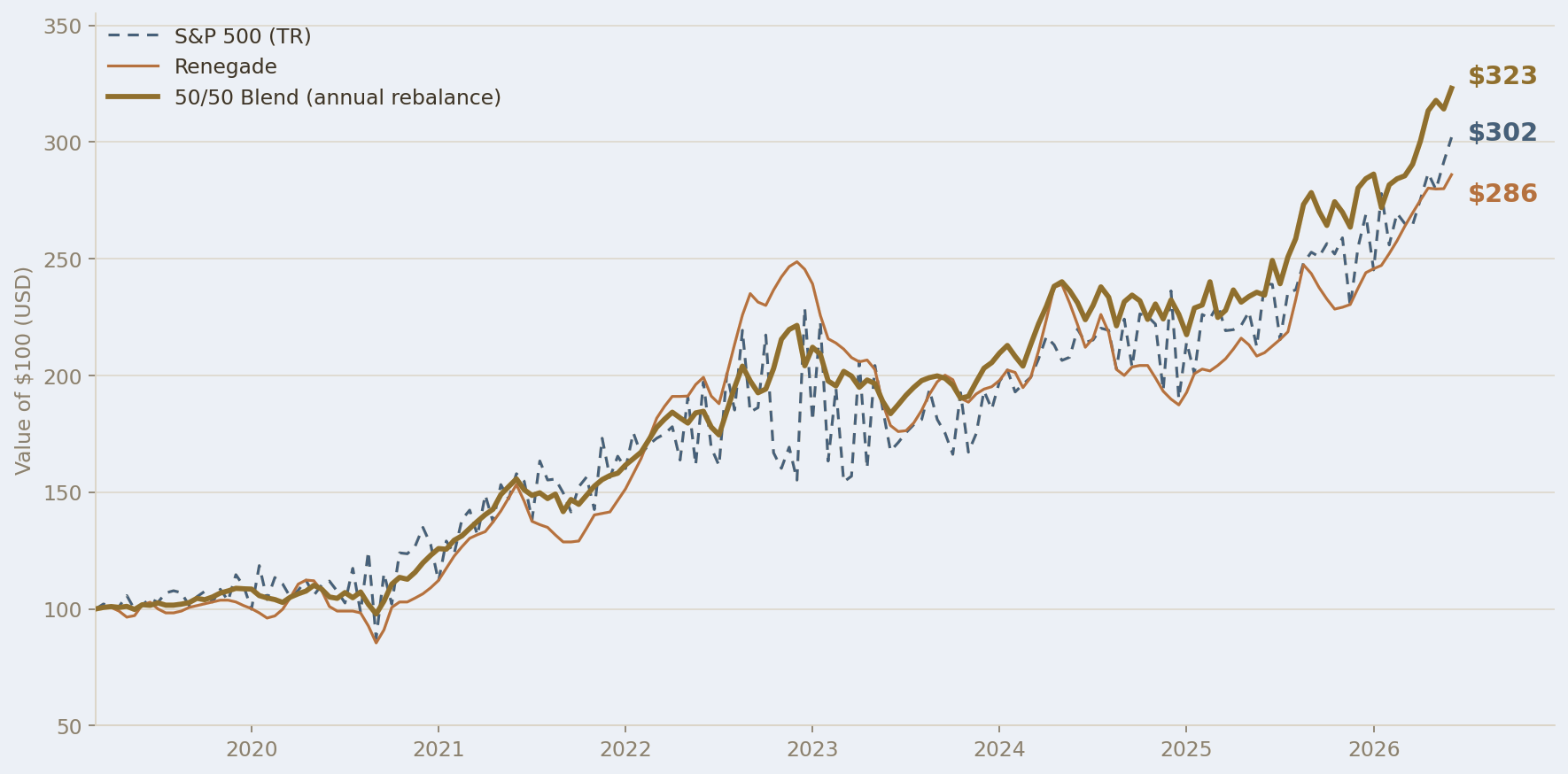 | | Monthly data. Blend rebalanced to 50/50 each 1 January. Renegade and S&P 500 total return, USD. Sources: Bloomberg (S&P 500), Renegade fund administrator. |
| | | Renegade’s monthly returns carry a correlation of −0.20 to the S&P 500. The fund’s best periods have tended to arrive when equities were weakest, most visibly through the 2022 bear market (Renegade fund returned 61.44% vs S&P 500 −18.11%). A 50/50 blend, rebalanced once a year, has returned 17.4% annualized — a 1.2% excess return versus the S&P 500 since the fund’s 2019 inception — while carrying 13.0% volatility, below both the fund and the index, cutting the maximum drawdown to less than half the S&P 500’s, and recording no losing calendar year in the sample, with a worst year of +3.4%. | | | 17.4% Blend annualized return | 13.0% Blend volatility | 0.99 Blend Sharpe ratio |
| | | Measured since the fund’s 2019 inception | Metric | Renegade | S&P 500 | 50/50 Blend | | Annualized return | 15.4% | 16.2% | 17.4% | | Volatility | 24.0% | 16.6% | 13.0% | | Sharpe ratio | 0.45 | 0.71 | 0.99 | | Max drawdown | −30.1% | −23.9% | −11.8% | | Worst calendar year | −19.5% | −18.1% | +3.4% | | Down years | 3 | 1 | 0 | | Growth of $100 | $286 | $302 | $323 |
| | | The 50/50 illustrative blend demonstrates a Sharpe ratio of 0.99 against 0.71 for the S&P 500 alone — a compelling enhancement to an index that has been tough to beat, and an outcome that is only possible through the use of an effective alternative strategy such as Renegade. Assumptions: blend assumes annual rebalancing each 1 January. Risk-free rate of 4.5% used for Sharpe. Sources: Bloomberg (S&P 500 total return), Renegade fund administrator. Past performance is not indicative of future results. | | |
| | | “ The measure of a hedge fund is not its own return. It is the return of your portfolio after you add it.  Henry Biddlecombe Chief Executive Officer | | |
| | | Why AG Capital Let’s grow together. Our active management approach allows the investment team to respond to changing market conditions, identify opportunities, and focus on long-term capital growth while maintaining a disciplined risk framework. | | |
| | | | Copyright © 2026 AG Capital. All rights reserved.
You are receiving this email because you opted in via our website. | | | AG Capital · 7th Floor, 20 Vineyard, 20 Vineyard Road, Claremont,
Cape Town, Western Cape 7708, South Africa | | | AG Capital (Pty) Ltd is an authorised Financial Services Provider, FSP No. 43325.
Company Registration Number: 2010/012989/07.
Your details are processed in line with POPIA and are never shared. | | | | | | subscribe · past editions | | | | The Diagonal · Occasional. Not daily. |
|
|